
Engineering & design
Custom Magnet Design
From an application requirement to a magnetic solution.
Bring your operating conditions, design constraints and performance targets into one engineering conversation. SDM Magnetics supports the development of permanent magnets and custom magnetic assemblies with an application-led approach.
01
Magnetic Engineering Support
Define what the magnetic component needs to achieve in its operating environment.
02
Product Optimization
Consider magnetic performance, available space and manufacturing constraints together.
03
Custom Solutions
Explore a magnet or integrated assembly around the requirements of your application.
01 / Engineering support
Start with the application.
A magnet does not operate in isolation. Its surrounding structure, air gap and working environment help define a useful design brief.
Operating environment
Describe working and peak temperatures, moisture, corrosion exposure, vibration and any contact with fluids. These conditions inform material and surface-treatment discussions.
Space, air gap and interfaces
Share the available envelope, mating parts, mounting method and expected air gap. A field or force requirement is more meaningful when its measurement position and mechanical interfaces are defined.
Magnetic performance targets
Specify the required magnetic field, holding or attractive force, or transmitted torque, together with the operating conditions and test method. Identify which requirements are essential and which can be discussed.
Where finite element analysis fits
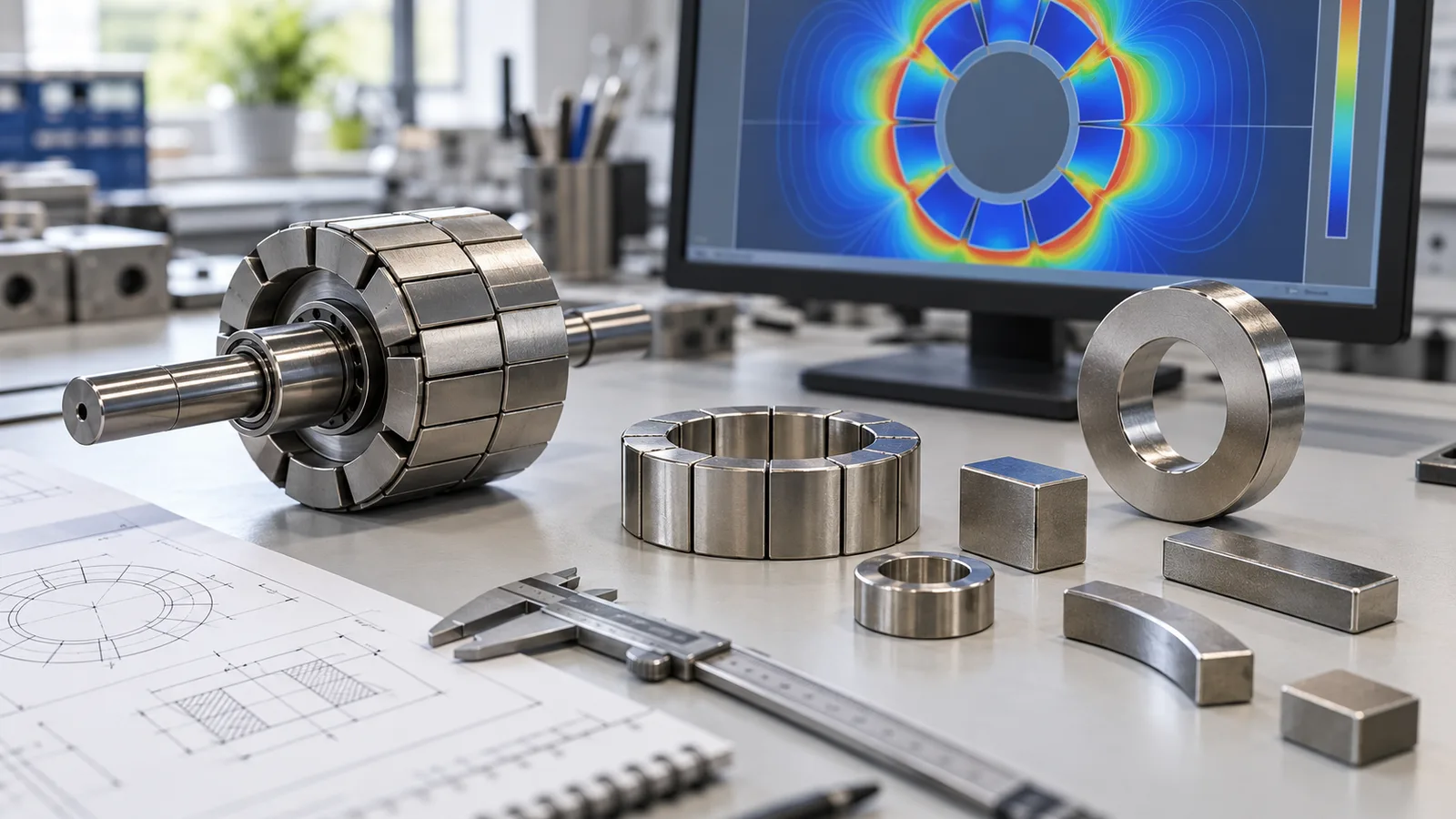
Finite element analysis can help explore magnetic-field distribution, attractive force and torque during early design discussions. Its usefulness depends on the geometry, material inputs and boundary conditions; calculations do not replace validation under the intended operating conditions.
02 / Product optimization
Balance the design, not just the magnet.
Material, geometry and manufacturing choices affect one another. Review the trade-offs before committing to a component drawing.
Material selection
Discuss NdFeB, SmCo, ferrite, AlNiCo or bonded magnet options in relation to temperature, magnetic demand and the application environment. A higher nominal grade is not automatically the most suitable choice.
Geometry & manufacturability
Review dimensions, thin sections, holes, edges and assembly clearances. Discuss which features are functionally important and how they relate to machining, molding and handling.
Magnetization
Define the magnetization direction, pole arrangement and relationship to surrounding parts. For arrays and assemblies, explain the desired field region and orientation.
Coating & integration
Consider environmental protection alongside adhesive, mechanical retention and fit. Coating thickness and assembly interfaces belong in the same dimensional discussion.
03 / Custom solutions
Develop around your interfaces.
The solution may be a permanent magnet, an arranged magnetic array or a magnet integrated into a mechanical component.
Explain where the component fits in your system, how it will be assembled and what needs to be checked. Existing drawings or an initial concept can provide a starting point without implying that every design decision is already fixed.
Prototype discussions can help identify how a design and its function should be verified. The appropriate sample scope and validation plan should be agreed for the specific project.
A focused engineering conversation.
Define the next decision at each stage, from requirements to prototype evaluation.
01
Requirements discussion
Clarify the application, interfaces, operating conditions and essential performance targets.
02
Design evaluation
Discuss material and geometry options, manufacturing considerations and questions requiring further analysis.
03
Prototype & validation planning
Agree what a sample needs to demonstrate, how it will be tested and which observations will guide the next revision.
What to prepare for your project.
Share what is available and identify what is still open. A clear brief makes the discussion more useful.
- Application: the component’s function and its surrounding system.
- Drawings & dimensions: sketches, CAD or drawings, envelope, interfaces and air gap.
- Operating conditions: temperature range, environment and mechanical exposure.
- Performance target: field, force or torque, measurement position and validation method.
- Project scope: expected quantity, prototype needs and current development stage.
Bring your magnetic design into the conversation.
Tell us what your component needs to do, the constraints it must meet and the stage your project has reached.